Bennington
HISTORIC HONOR IN SUNDERLAND: New Marker Commemorates Literary Pioneer Lucy Terry Prince
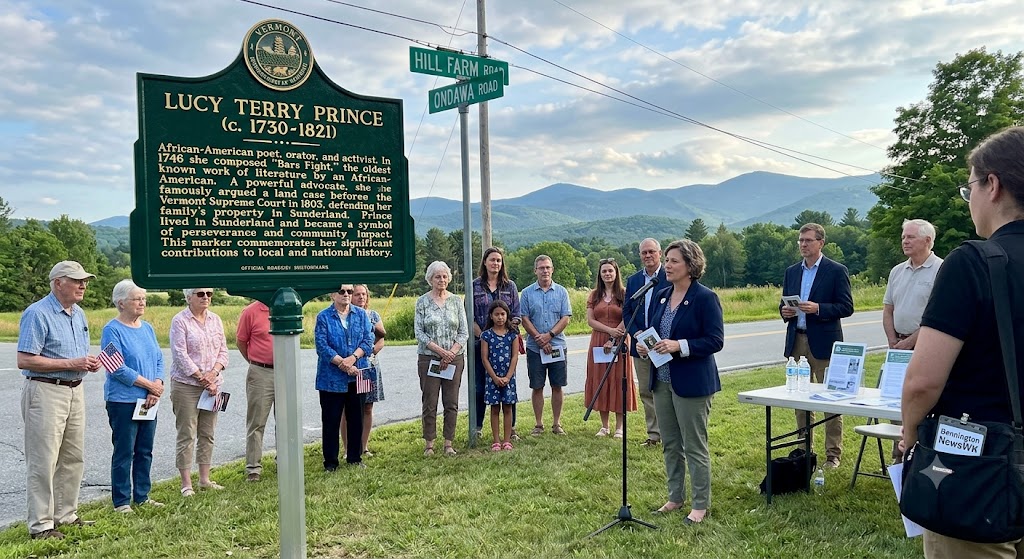
Local residents gathered in Sunderland on July 26 to honor Lucy Terry Prince, an early African-American poet and writer, with a new historic marker. This ceremony, held at the intersection of Hill Farm Road and Ondawa Road, drew over 40…

Last updated:
By Randy Breland, Editor | Bennington.newswk.com
BENNINGTON, VT — Local residents gathered in Sunderland on July 26 to honor Lucy Terry Prince, an early African-American poet, orator, and activist, with a new historic marker. The ceremony, held at the intersection of Hill Farm Road and Ondawa Road, drew over 40 attendees who celebrated Prince’s remarkable life and contributions to both state and national history.
According to a report first published by the Bennington Banner, the event included speeches highlighting her legal battles, literary achievements, and unmatched resilience.
📜 The Extraordinary Life of Lucy Terry Prince
To understand the weight of the new marker, one must understand the formidable woman behind it. Born in West Africa around 1730, Prince was kidnapped as an infant and brought to the American colonies through the transatlantic slave trade. She was eventually sold to Ebenezer Wells of Deerfield, Massachusetts, where she spent her youth enslaved.
Despite the brutal realities of her upbringing, Prince demonstrated exceptional intellect and storytelling ability from a young age. In 1746, at roughly 16 years old, she composed “Bars Fight,” a rhyming ballad detailing a deadly ambush on local settlers. The piece was passed down orally for over a century before finally being published in 1855, securing her place in history as the author of the oldest known work of African-American literature.
In 1756, she married Abijah Prince, a prosperous free Black man and veteran of the French and Indian War who purchased her freedom. The couple moved to Vermont, where they raised six children and established themselves as hardworking landholders.
Throughout her life, Prince became widely renowned for her powerful public speaking and fierce advocacy:
- The Fight for Education: She famously delivered a passionate, three-hour speech to the Board of Trustees at Williams College in an attempt to secure admission for one of her sons, quoting scripture and law (though the college ultimately denied him based on race).
- Defying Violent Harassment: When racist neighbors systematically vandalized the family’s farm in Guilford, Prince traveled on horseback directly to the Governor’s Council in 1785, convincing state leaders to order local selectmen to protect her family.
- Supreme Court Victory: After moving to Sunderland, Prince successfully defended her family’s property against a land-grabbing neighbor, Colonel Eli Bronson. She personally presented her case before the circuit court. The presiding judge—U.S. Supreme Court Justice Samuel Chase—later remarked that her oral argument was more persuasive than that of any lawyer he had heard in Vermont.
Prince lived in Sunderland until her death in 1821 at the age of 91, leaving behind a legacy as a trailblazing orator who refused to be silenced.
🏛️ Community Recognition & Ongoing Legacy
The unveiling ceremony featured remarks from local historians and community leaders, including Mia Schultz, President of the Rutland Area NAACP, who emphasized Prince’s legacy not just as a poet, but as an enduring symbol of perseverance.
“You survived the unimaginable reality of enslavement, but you claimed your freedom,” Schultz noted during her speech.
Local historian Avis Hayden also shared insights into Prince’s impact on the Sunderland community, highlighting her role as a master storyteller whose voice refused to be erased by time.
This new marker is the second honoring the Prince family in Vermont, with the first located at the Guilford Welcome Center. In 2021, a memorial tree was planted at Sunderland Town Hall to commemorate the bicentennial of her passing. The new historic site marker serves as a permanent, physical reminder of her contributions and enriches ongoing conversations surrounding Vermont’s complex racial history.
As communities across Southwestern Vermont reflect on their heritage, the recognition of figures like Lucy Terry Prince offers a powerful opportunity to engage with the past, reclaim forgotten narratives, and inspire future generations.
This article was produced with the assistance of AI and reviewed by our editorial team. Based on reporting originally published by the Bennington Banner.
See a typo? Report it here.