Bennington, VT News
Batten Kill River Restoration Sunderland Project Revitalizes Local Waterways
Conservation groups, including Trout Unlimited, are restoring the Batten Kill River and Tanner Brook in Sunderland, Vermont. The project repairs eroded banks, reconnects floodplains to prevent downstream flooding, and improves cold-water habitats for wild trout.

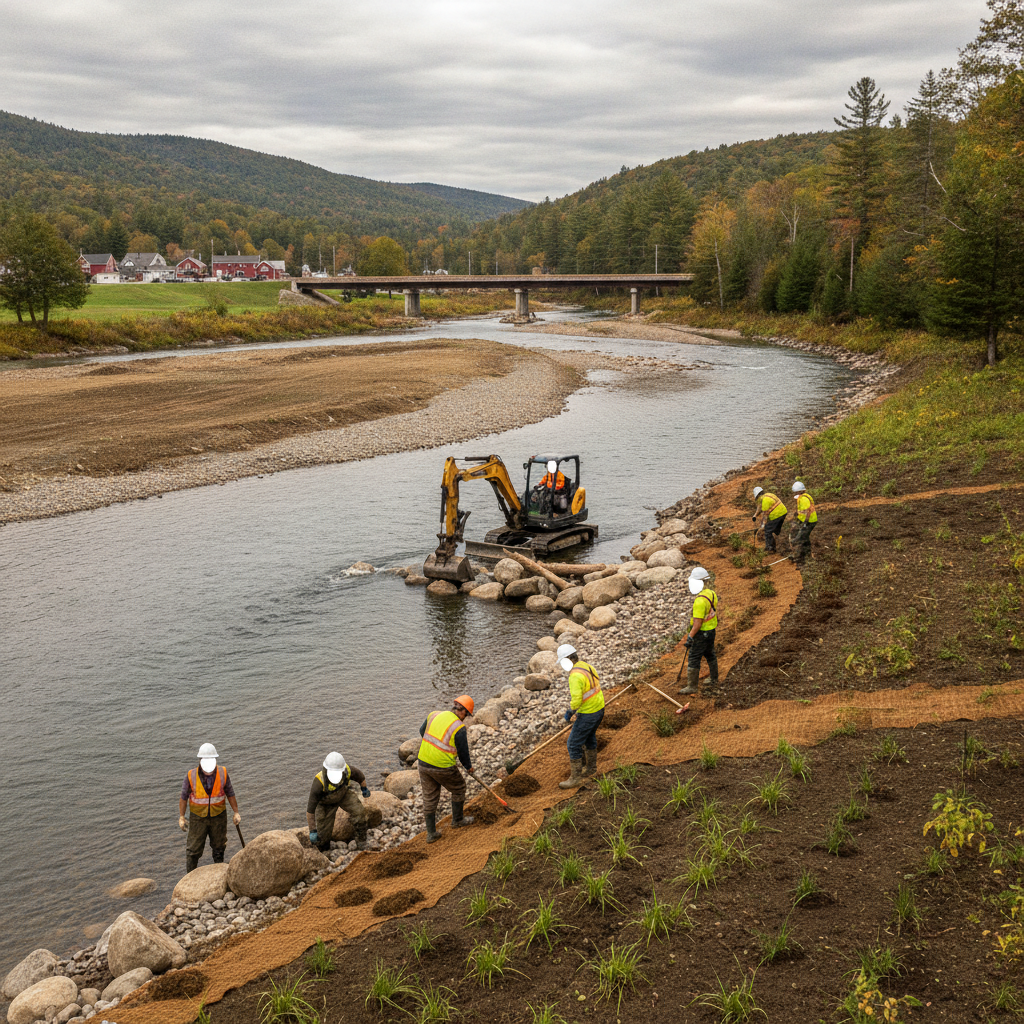
Our local waterways are vital to both wildlife and communities in Bennington County. In Sunderland, conservation teams have mobilized to repair the Batten Kill River and Tanner Brook. This project helps prevent downstream flooding in nearby towns like Arlington and Manchester. Additionally, it restores critical cold-water habitats for wild brook and brown trout. This vital work supports our local outdoor recreation economy.
Why it matters
Healthy floodplains act as natural sponges for our area. When rivers cannot access their floodplains, high water rushes downstream with destructive force. By restoring these natural systems, the project protects local infrastructure. Consequently, it improves water quality for everyone in our community.
What is the Sunderland River Project Vermont aiming to accomplish?
The Sunderland River Project in Vermont aims to repair decades of agricultural damage along the Batten Kill River. By reshaping eroded banks and reconnecting the river to its natural floodplain, this initiative will slow high-water flows. Ultimately, these efforts will restore vital cold-water fish habitats and protect downstream communities from severe flooding.
For decades, farming and mowing directly to the water’s edge weakened the riverbanks. Consequently, the river cut deeply into the channel. This deep cut caused severe erosion and raised water temperatures. To reverse this damage, heavy machinery is now actively transforming the landscape.
Several key conservation partners are collaborating on this initiative. Specifically, the Trout Unlimited Battenkill team is overseeing the in-stream habitat work. The full list of collaborating groups includes:
- Trout Unlimited: Leading the in-stream and tributary work through the Battenkill Home Rivers Initiative.
- Ducks Unlimited: Managing the adjacent former agricultural parcel to establish new wetlands.
- Local Coalitions: Partners include the Battenkill Conservancy, the Batten Kill Watershed Alliance, and the Bennington County Conservation District.
Why is the Batten Kill floodplain restoration necessary?
The Batten Kill floodplain restoration is necessary because severe bank erosion threatens local water quality and community safety. Decades of agricultural wear created an unstable, eight-foot vertical drop that traps high-volume flows. By restoring natural floodplain access, this project allows high waters to spread safely, reducing downstream flood risks.
Because the narrow channel trapped the water, high flows accelerated downstream flooding. This confinement also caused severe vertical scouring. Furthermore, it raised water temperatures and harmed local fish populations. By contrast, the south bank retained its natural floodplain access. Therefore, it served as a perfect blueprint for the restoration.
To fix the north bank, crews are using heavy excavators. They are grading the eight-foot drop back approximately 10 feet from the waterline. This work creates a stable two-to-one slope. Next, workers are carving out a 20-foot “bankfull bench” to act as a level terrace.
“By giving the Batten Kill a bench at bankfull level, the project allows water to spread out horizontally instead of just cutting down vertically,”explained
Jacob Fetterman, project coordinator and fisheries biologist for Trout Unlimited.
Additionally, crews are anchoring large felled trees along the river margins. These mainstem wood additions will provide complex holding cover for wild trout. As a result, fish can find shelter against strong currents.
How Trout Unlimited Battenkill Protects Wild Trout in Tanner Brook
The Tanner Brook restoration protects wild trout by creating deep, cool pools in a vital cold-water tributary. By installing ten Beaver Dam Analogs, crews are raising the local water table. These simple wooden structures slow currents and provide critical winter refuge, keeping the brook cool during hot summer months.
Tanner Brook is a cold-water tributary of the Batten Kill River. Because it has lower-energy flows, it is the perfect environment for these light wooden structures. To build them, workers drive rows of wooden posts into the streambed. Then, they weave these posts with branches and brush.
These analogs mimic natural beaver dams. Consequently, they pond water and slow the current. They also foster vital groundwater exchange. This exchange helps moderate water temperatures throughout the year.
What is the timeline for the project?
The active construction phase of the project will conclude in distinct stages between 2026 and 2027. Heavy earthmoving, bank tapering, and floodplain excavation will wrap up in late September 2026. Following this initial phase, teams will focus on extensive planting and wetland restoration over the next year.
Our local environment will also see continuous improvements over the next several months. Specifically, the project timeline includes several key milestones:
- September 2026: Completion of heavy excavation and bank grading.
- Fall 2026: Planting of native trees and shrubs to stabilize the new banks.
- Spring and Summer 2027: Ducks Unlimited will expand the riparian buffer and restore wetlands on the adjacent parcel.
Ultimately, these efforts rely on natural processes to succeed. Human engineering only provides the initial foundation for long-term recovery.
“The project’s role is to set up conditions, gradual slopes, deep roots, room to move, to ensure that, over years and decades, the channel can shift in a way that is safer for downstream communities and more supportive of aquatic life,”Fetterman said.
Sources
- https://vtdigger.org/2026/09/24/restoring-the-rivers-memory-bringing-back-the-banks-of-the-batten-kill
- https://prioritywaters.tu.org
- https://www.ducks.org/conservation/mitigation/vermont-in-lieu-fee-program
This article was produced with the assistance of AI and reviewed by our editorial team.
Related: Green River Restoration Sandgate VT: Project Reconnects Floodplain to Heal Landslide Scars
Related: Green River Restoration Sandgate VT Project Tames 220-Foot Landslide
See a typo? Report it here.