Bennington
Federal Vaccine Order Targets New York and Neighboring States
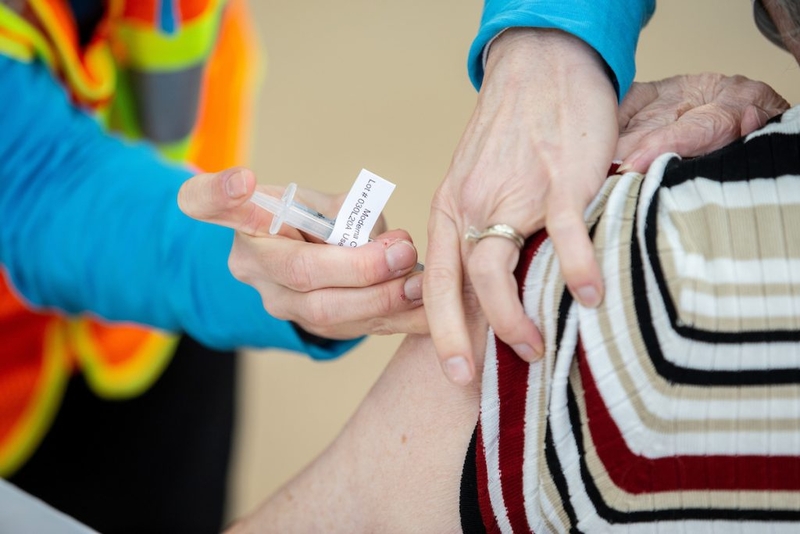
A largely overlooked part of the executive order President Donald Trump issued this week scaling back the schedule for childhood vaccines threatens legal action against the four states that don’t allow personal or religious exemptions to school vaccine requirements. Those…

Last updated:
Key points
Federal Vaccine Order Targets New York and
- A new federal executive order directs legal action against states that prohibit religious and personal school vaccine exemptions.
- New York is among four states without nonmedical exemptions, maintaining vaccination rates above 95 percent alongside low measles counts.
- Health experts warn that relaxing school vaccine mandates could worsen rising nationwide outbreaks of measles and whooping cough.
NewsWK — A new federal directive threatening legal action against states that restrict nonmedical school vaccine exemptions has sparked intense discussion across Southern Vermont and neighboring eastern New York border towns. The order places a spotlight on state public health mandates that directly affect regional families, school districts, and healthcare providers.
President Donald Trump signed an executive order directing the United States Attorney General to take legal action against states that do not provide religious and personal exemptions for childhood and adolescent immunization requirements. Four states currently prohibit nonmedical exemptions for public school attendance: New York, Maine, Connecticut, and California.
Why it matters here
For residents in Bennington County and adjacent communities in Rensselaer and Washington counties in New York, state vaccination rules play a vital role in daily life. Families routinely cross state lines between Bennington, Hoosick Falls, and White Creek for schooling, youth sports, and medical care, creating an interconnected regional health environment.
New York removed nonmedical exemptions for school vaccinations in 2019, joining a small group of states with strict public health requirements. Local health administrators emphasize that maintaining high immunization rates helps safeguard vulnerable individuals, including infants and immunocompromised neighbors, across our shared community.
Changes or legal challenges to state health mandates in nearby New York could alter enrollment rules for regional families whose children attend school or participate in multi-state programs near the Vermont border.
National trends and regional impact
All 50 states and the District of Columbia mandate specific immunizations for public school entry, and every jurisdiction permits exemptions for legitimate medical reasons. However, 46 states and the District of Columbia also permit parents to opt out based on religious or personal beliefs.
The four states that limit exemptions to medical criteria maintain some of the highest childhood vaccination rates in the nation. Public health agencies report that California, Connecticut, Maine, and New York all maintain school immunization rates above 95 percent, a key threshold required to achieve community herd immunity.
By contrast, states experiencing the largest surges in preventable disease permit nonmedical exemptions. Nationwide measles cases have climbed to their highest numbers since 1991, driven largely by outbreaks in states with lower vaccination coverage.
South Carolina has recorded 670 measles cases this year, followed by Utah with 524 cases, Pennsylvania with 216 cases, Texas with 216 cases, and Virginia with 176 cases. Among those five states, only Virginia maintains an overall school vaccination rate above 95 percent, though localized pockets in rural Virginia counties drop below 75 percent.
Meanwhile, the four states targeting strict exemptions have contained disease numbers significantly better. California has reported 52 measles cases, New York has reported 10 cases, Maine has reported five cases, and Connecticut has recorded two cases.
Rising risks from preventable illnesses
Measles is not the only preventable condition causing concern among medical professionals. Fatalities from whooping cough, officially known as pertussis, are also climbing nationwide.
Health agencies recorded 32 whooping cough deaths nationally last year, marking the highest annual total for the infection since at least 1999. Before widespread pertussis vaccines were introduced in the 1940s, as many as 200,000 American children contracted whooping cough annually, resulting in approximately 9,000 deaths each year.
Recent fatalities include three whooping cough deaths in Kentucky and two in Louisiana, signaling renewed risks when community immunization levels dip.
Medical experts raise concerns
Public health professionals caution that federal directives questioning state immunization standards create confusion for parents weighing health choices for their children.
Dr. Thomas Lew, a clinical assistant professor at the Stanford University School of Medicine, observed that the executive order “puts a lot of misinformation and a lot of fear and doubt in parents’ minds,” adding that it “clouds the conversation around vaccines and their importance and their safety.”
Pediatric specialists stress that school exemptions can erode the baseline protections that keep classrooms open and safe during disease season.
Dr. Molly O’Shea, a pediatrician practicing in suburban Detroit, noted that nonmedical exemptions “increase the number of parents who opt to forgo one or more vaccines for any list of reasons.” She explained that “the learning environment is then more fragile because of the risk of disruption by infectious illness.”
At the same time, practitioners stress the importance of understanding parental concerns when discussing immunization schedules with families.
What’s next for regional policies
Legal analysts note that any federal attempt to overturn state immunization laws will face lengthy legal challenges in court. State public health authority has traditionally remained grounded in state police powers granted under the United States Constitution.
State leadership in the affected states has reaffirmed a commitment to existing health statutes. Governors and state health directors, including Maine Governor Janet Mills, announced that local vaccination policies will remain unchanged despite the executive order.
For parents and school officials in Southern Vermont and neighboring eastern New York, existing state immunization rules remain fully in effect for the upcoming school year. School nurses and local pediatric clinics continue to recommend that families review student immunization records well ahead of classroom registration.
This article was produced with the assistance of AI and reviewed by our editorial team.
Sources
Related: How Cancer Vaccine Hesitancy Could Threaten New Medical Treatments
Related: New York Measles Emergency Sparks Action Near Vermont Border
See a typo? Report it here.