Bennington
State Lawmakers Push Nearly 250 Bills to Limit Federal Immigration Enforcement
Democratic lawmakers proposed nearly 250 bills in state capitols this year seeking to limit federal immigration efforts as they sought to push back against what they view as federal government overreach. In a new report tallying 2026 action, State Futures,…

Last updated:
Key points
State Lawmakers Push Nearly 250 Bills to Limit
- State lawmakers introduced 242 bills across 32 states in 2026 to curb federal immigration enforcement, with 53 measures passing in 17 states.
- Key provisions target sensitive locations like courthouses, schools, and hospitals, alongside measures for data confidentiality and detention facility inspections.
- Several measures face legal challenges in federal court, while some Democratic governors have raised concerns over potential conflicts for local law enforcement.
NewsWK — State lawmakers across the country introduced nearly 250 bills this year aimed at restricting federal immigration enforcement, reflecting a coordinated effort to counter federal policies through state-level statutory protections.
The legislative push, tracked in a 2026 report by the nonprofit network State Futures, includes 242 separate measures introduced across 32 statehouses. The group, which coordinates hundreds of Democratic state legislators nationwide, reported that 53 of those bills successfully passed through 17 state legislatures, though several have faced gubernatorial vetoes or ongoing legal reviews.
Why it matters here
For residents in Bennington County and neighboring communities across the New York and Massachusetts borders, state-level immigration policies shape how public institutions operate every day. In border areas where residents travel between jurisdictions for work, healthcare, and education, guidelines governing courthouses, schools, and hospitals directly affect community trust and public safety.
As federal immigration enforcement ramps up during President Donald Trump’s second term, statehouses in the Northeast and across the country are defining the legal boundaries for local law enforcement, healthcare providers, and judicial staff.
Protections in sensitive locations and public spaces
A significant portion of the proposed legislation focuses on establishing safeguards in sensitive locations where residents seek essential services. Measures introduced this year seek to prevent arrests on school grounds, inside medical centers, and within local courthouses.
In Rhode Island, lawmakers enacted legislation in June specifically shielding individuals from immigration arrests while attending court proceedings. Under the new statute, individuals who violate the policy face contempt of court citations and may be sued by those subjected to warrantless arrests.
Rhode Island state Sen. Tiara Mack, who co-chairs a federal response working group for State Futures, noted that state lawmakers are actively collaborating across jurisdictions to share effective statutory language.
“This new landscape requires legislators to really own the narrative and own the reality that federalism is something that we can use as a tool to strengthen protections for our state,” Mack said, “and we have to work with states across the country.”
Varied state strategies and executive responses
State responses have varied widely, with governors taking differing approaches to the proposed legislation. In Oregon, Gov. Tina Kotek signed eight measures in April designed to protect immigrant rights. These statutes prevent enforcement actions in schools and hospitals, safeguard personal data privacy from federal agencies, and grant individuals the legal standing to sue over statutory violations.
Other measures have encountered executive hesitation. In Virginia, Gov. Abigail Spanberger vetoed a bill that would have prohibited immigration enforcement inside hospitals, courthouses, and schools. In her veto statement, the governor noted concerns that the measure could place security guards and local police officers in conflicting legal positions between state and federal mandates. In Delaware, similar legislation sponsored during the legislative session remains under review by Gov. Matt Meyer.
Oversight of detention facilities and identification rules
Lawmakers have also pursued measures addressing regulatory oversight and officer identification rules. In California, a proposal aimed at preventing state and federal law enforcement officers from wearing masks while conducting operations was halted by a court after a judge ruled it improperly singled out federal agents by exempting state personnel.
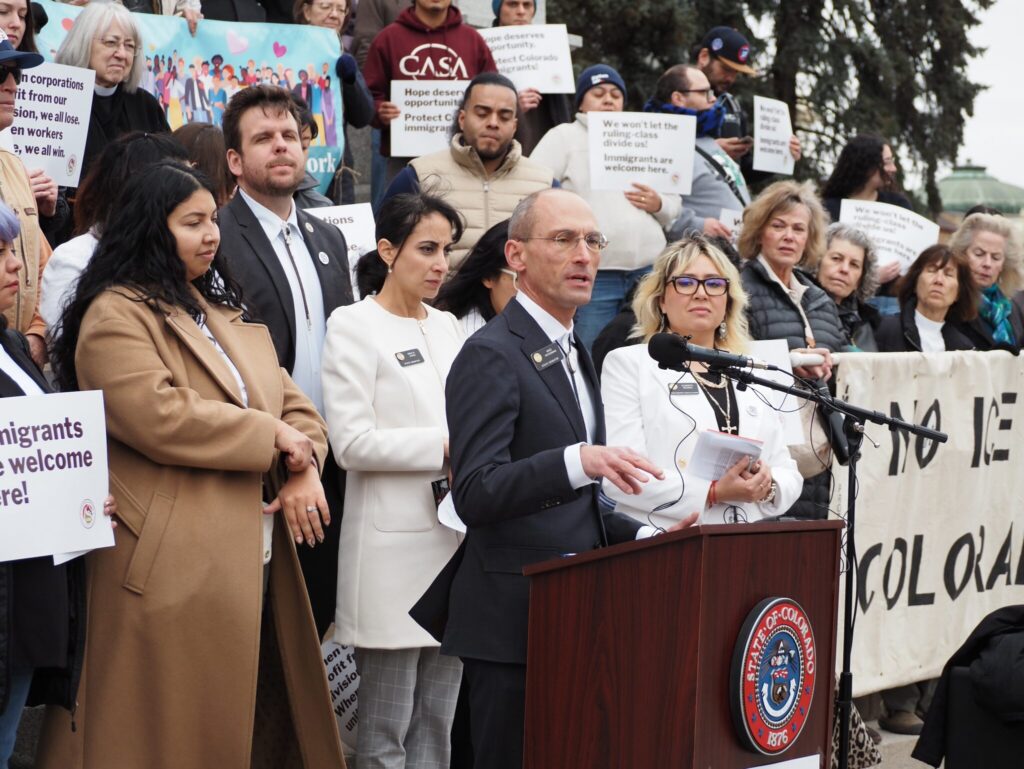
In Colorado, lawmakers passed legislation expanding the state health department’s oversight over immigration detention centers. The statute mandates compliance with state health codes and reporting standards. That measure is currently facing a legal challenge from a private detention facility operator after state regulators sought inspection access following a reported case of tuberculosis among detainees.
Colorado state Sen. Mike Weissman, a sponsor of the Colorado law, emphasized that state lawmakers have increased their coordination regardless of geographic region.
“We all talk because we all have the same concerns,” Weissman said, “and that is to protect the basic freedoms of our people from an absolutely out of control federal regime.”
Background and the shift toward federalism
The wave of legislation highlights a broader political evolution as Democratic state leaders increasingly utilize federalism, the constitutional separation of powers between state and federal governments, to enact independent safeguards. While states’ rights arguments have historically been associated with conservative politics, state legislators are now relying on state sovereignty to check federal authority.
Courts across several jurisdictions continue to review the newly enacted laws to determine where state regulatory power ends and federal supremacy begins.
What to watch next
As state legislative sessions conclude and governors finalize actions on pending bills, legal challenges from federal agencies and private operators are expected to test the limits of these state measures in federal court. Local municipalities and public service agencies will continue monitoring these cases to ensure compliance with both evolving state protections and federal legal mandates.
This article was produced with the assistance of AI and reviewed by our editorial team.
Sources
Related: New York AI Regulation: What the RAISE Act Means for Our Region
Related: Trump EPA Power Plant Emissions Rollback Draws Regional Focus
See a typo? Report it here.