
Bennington
How Changing Kratom and 7-OH Laws Impact Bennington Area Border Communities
For years, the psychoactive compound kratom has been sold across much of the United States as an herbal supplement, available in powders, capsules and extracts with few of the restrictions applied to controlled substances. But the market is changing. Products…

Last updated:
Key points
- Massachusetts and New York have taken vastly different approaches to regulating kratom and its concentrated derivatives, creating a legal maze for tri-state travelers.
- Health officials warn that highly concentrated 7-OH products pose significantly higher addiction and dependency risks than traditional natural leaf kratom.
- The federal Drug Enforcement Administration is moving to classify high-potency synthetic kratom compounds as Schedule I controlled substances while leaving traditional leaf unregulated.
NewsWK — For residents in the Bennington region, crossing state lines is a daily routine. However, driving into nearby Massachusetts or New York now brings a confusing mix of legal standards. Local convenience stores and smoke shops face a shifting landscape. Meanwhile, lawmakers scramble to address new, highly concentrated products.
How do these changing rules impact Southern Vermont families?
Local families must navigate a complex patchwork of rules when traveling just a few miles from home. In fact, Vermont borders states with vastly different policies. Therefore, residents can easily cross into areas with total bans or strict age limits. This regulatory divide creates confusion for consumers, retailers, and local health officials alike.
For example, a resident of Pownal driving south into Williamstown, Massachusetts, enters a strict temporary ban. Meanwhile, a driver heading west from Old Bennington into Hoosick Falls, New York, encounters different rules. Furthermore, these geographic differences highlight major regulatory challenges. The substance remains widely accessible yet poorly understood.
Local retailers in North Bennington and Shaftsbury must also track these regional shifts. As a result, some shops pull certain products voluntarily to avoid liability. Others wait for clearer guidance from state and federal officials.
What are the current New York kratom regulations and surrounding state rules?
New York kratom regulations and neighboring state policies vary widely, creating a legal maze for regional travelers. While some states allow natural leaf sales with age limits, others have enacted complete bans. Consequently, these differences make it difficult for tri-state residents to know what is legal in each jurisdiction.
The regional differences are especially stark. In August, Massachusetts Democratic Gov. Maura Healey issued an executive order. This order temporarily placed all forms of kratom into Schedule I under state law for one year. Consequently, the Massachusetts kratom ban represents one of the strictest approaches in the nation.
In contrast, New York lawmakers have debated specific synthetic kratom restrictions rather than an outright ban. Nearby Rhode Island also shifted its approach this year. The state replaced its total ban with a regulated market for adults aged 21 and older. However, Rhode Island still strictly prohibits synthetic compounds.
- Massachusetts: Imposed a temporary one-year ban on all kratom products.
- New York: Focuses on labeling, age limits, and synthetic kratom restrictions.
- Rhode Island: Allows natural leaf for adults over 21 but bans synthetic versions.
- Vermont: Continues to monitor the regional landscape as neighboring laws shift.
How do shifting kratom and 7-OH laws affect local tri-state retailers?
Shifting kratom and 7-OH laws force local retailers to monitor state lines closely to avoid legal trouble. For instance, shops in Hoosick Falls or Williamstown must comply with completely different product standards. This regulatory mismatch creates major compliance hurdles for business owners who serve customers from multiple states.
Many local shop owners feel caught in the middle. They want to offer popular products, but they fear sudden legal changes. As a result, some border-town stores have stopped carrying concentrated extracts entirely. Specifically, they worry about vague guidelines regarding kratom and 7 OH laws across state lines.
Why are health officials raising questions about 7-hydroxymitragynine safety?
Medical experts worry about 7-hydroxymitragynine safety because highly concentrated forms act intensely on brain receptors. Traditional kratom leaves contain only trace amounts of this alkaloid. However, new synthetic and concentrated products target the same brain receptors as powerful prescription opioids. Therefore, these potent products significantly increase addiction risks.
Traditional kratom comes from the Mitragyna speciosa tree, native to Southeast Asia. For generations, people chewed the leaves or brewed them into tea. In small doses, the plant acts as a mild stimulant. In larger doses, however, it provides a sedative effect.
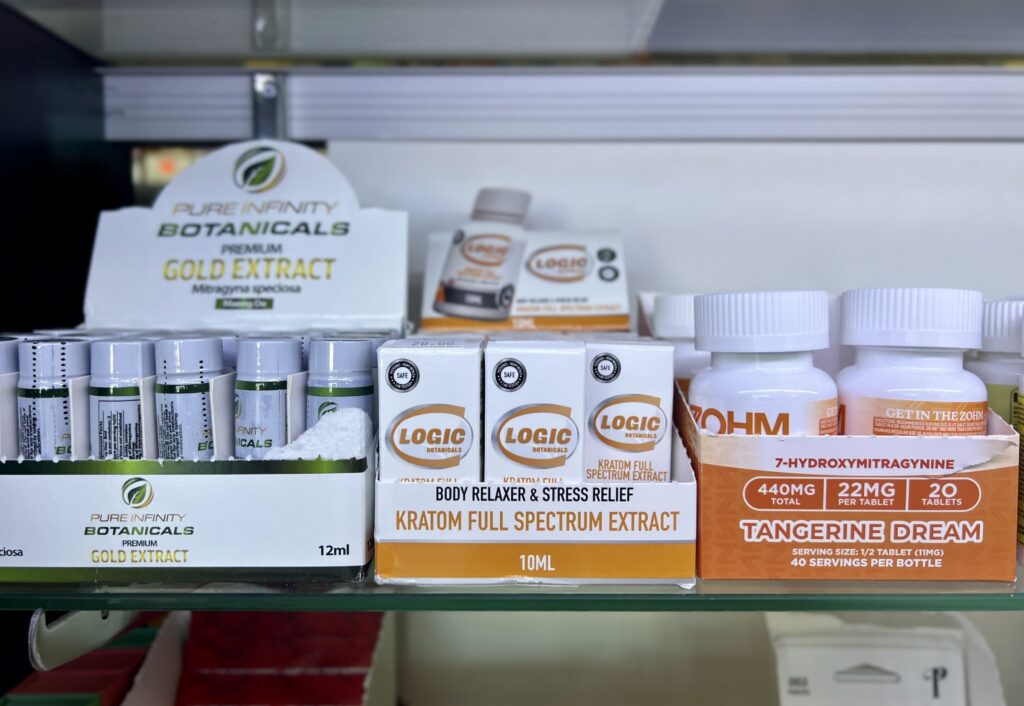
Yet the commercial market has changed dramatically. Manufacturers now sell concentrated liquids, capsules, and gummies. These products often contain high levels of 7-hydroxymitragynine, or 7-OH.
How does 7-hydroxymitragynine safety compare to traditional leaf use?
Traditional leaf products contain low levels of natural active compounds. In contrast, newer processed products isolate and concentrate these chemicals to create highly potent extracts. This chemical concentration significantly increases the risk of physical dependence for users. In addition, users face severe withdrawal symptoms.
The primary concern centers on how these concentrated products interact with the human body. Dr. Alta DeRoo, the chief medical officer of the Hazelden Betty Ford Foundation, explained the difference. “It’s easier to become dependent and more euphoric with the 7-OH, and so coming off of it is more dramatic as well,” DeRoo said.
Because of these risks, poison control centers have reported a massive surge in calls. Nationally, kratom exposure reports rose by about 1,200% between 2015 and 2025. Through June of this year, poison centers logged more than 3,100 reports. If this trend continues, 2026 will see a 68% increase in exposures compared to last year. Consequently, this trend raises urgent questions about 7 hydroxymitragynine safety.
Dr. Sarah Kawasaki, an associate professor at Pennsylvania State University, also urged caution regarding the lack of research. “What we don’t know, and its accessibility, should scare us all,” Kawasaki said.
How will federal agencies shape future kratom and 7-OH laws?
Federal regulators plan to classify high-potency synthetic compounds as dangerous controlled substances while leaving natural leaf products alone. The Drug Enforcement Administration wants to place concentrated 7-OH and three related synthetics into Schedule I. Thus, this federal action aims to protect public health without banning traditional botanical products.
Overall, the federal government is moving toward a targeted regulatory approach. The DEA plans to target products with a 7-OH concentration above 0.05%. Crucially, this change will not affect natural botanical products that remain below this limit.
Meanwhile, the kratom industry itself is pushing for clearer rules. Many business groups openly support federal action against synthetic products. They want to protect the market for traditional leaf products. At the same time, they want dangerous synthetics off store shelves.
For local families in the Bennington area, these federal decisions will eventually bring consistency. Until then, residents must remain aware of the different rules in Vermont, New York, and Massachusetts.
This article was produced with the assistance of AI and reviewed by our editorial team.
Sources
Related: Border County Tax Pressures Mount as New York Shifts SNAP Costs
Related: Multistate Lawsuit Challenges Federal Immigration Rules on Public Safety Grants
See a typo? Report it here.