
Alabama
50-50 Child Custody Laws Gain Momentum Across States
A growing number of states are making an equal split between parents the default child custody option in divorce cases. Louisiana and Mississippi this year joined at least five other states that have adopted the so-called 50-50 standard — four of them…

Last updated:
Key points
- Seven states have enacted statutes establishing equal parenting time as the legal default in child custody cases.
- Supporters argue equal custody reduces parental conflict and protects father-child bonds, while critics worry about domestic safety and infant care.
- Researchers find that statutory custody changes have little measurable impact on overall state divorce rates.
NewsWK — A growing legal movement is reshaping how family courts decide child living arrangements after parents separate. Across the country, several state legislatures now establish equal parenting time as a baseline standard.
In Southern Vermont, New York, and Massachusetts, custody decisions still rely on judicial discretion. In addition, courts evaluate the best interest of each child. However, nationwide statutory debates over 50-50 child custody laws could influence regional reform efforts.
Why it matters
Child custody policies directly impact family stability, household finances, and child welfare across our communities. When family courts set legal defaults, parents face clear expectations before filing contested motions. In turn, these legal shifts change how local child support formulas operate for split households. Thus, clearer rules reduce costly disputes in county probate courts.
Family court battles often place heavy emotional and financial strain on working parents. For example, families across Bennington, Pownal, and Manchester face high legal expenses. Furthermore, state rules that alter baseline custody reshape mediation practices and daily parenting schedules.
How do 50-50 child custody laws reshape family court?
Shared parenting laws replace case-by-case starting points with an immediate legal assumption of equal time. Under these frameworks, judges must award equal physical custody by default. However, a judge can deviate if one parent presents clear evidence of harm. Consequently, courts no longer begin hearings with one parent holding primary physical custody.
Both Louisiana and Mississippi approved equal custody measures this year. Interestingly, political support for these bills crossed party lines. Democratic lawmakers led the measure in Louisiana. Meanwhile, Republican sponsors steered the bill through Mississippi.
In Louisiana, lawmakers changed statutory text so custody must divide equally. Specifically, the new statute replaced permissive “should” phrasing with mandatory “shall” language. In Mississippi, the new statute established equal time as the formal standard. Therefore, judges must order equal time unless a parent proves that equal time harms the child.
What changes under equal child custody?
A 50-50 custody divorce alters courtroom dynamics, daily parenting routines, and monthly support obligations. Under these statutes, courts presume equal residential placement from the start. As a result, traditional child support formulas adjust to reflect shared parenting time. Therefore, these statutory changes establish legal parity between parents right from the initial petition.
Under the revised Mississippi statute, the new shared custody formula can lower monthly child support payments. In particular, this adjustment helps the parent who earns less income. Consequently, financial adjustments remain closely tied to physical custody divisions.
These statutory shifts reverse decades of traditional court practices. Historically, family courts awarded mothers primary physical placement far more often than fathers. In contrast, newer statutory standards establish equal footing for both parents immediately.
Which states have adopted default child custody standards?
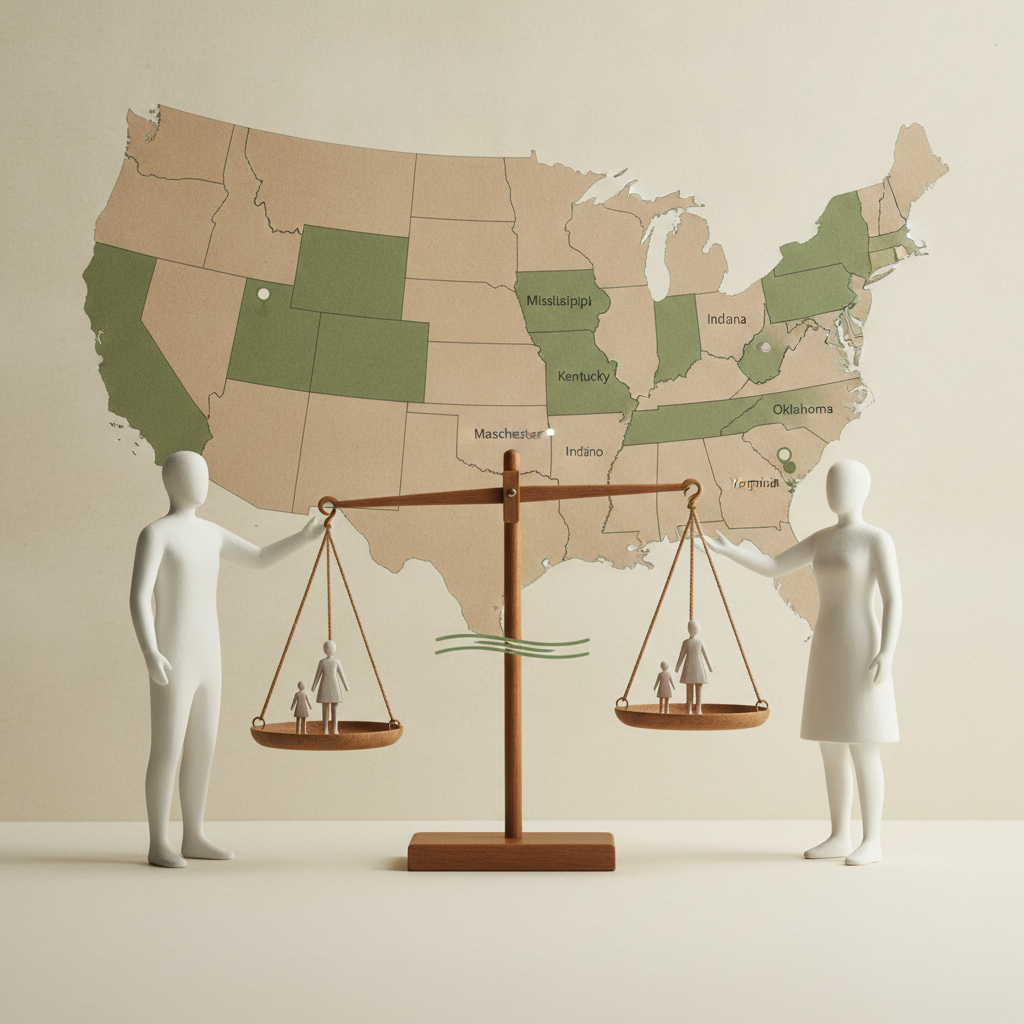
Seven states now enforce legal baselines that favor equal time splits between separating parents. Lawmakers approved each measure with bipartisan support over the past six years. Consequently, these statutory reforms reflect widespread legislative interest across diverse political environments. In addition, these laws establish equal parenting as the initial starting point in custody disputes.
The seven states that have established equal parenting defaults include:
- Kentucky, which enacted its landmark statute in 2018
- Arkansas, which passed its custody measure in 2021
- West Virginia, which codified its standard in 2022
- Florida, which adopted its baseline law in 2023
- Missouri, which enacted equal time rules in 2023
- Louisiana, which updated its custody statutes in 2024
- Mississippi, which passed its default rule in 2024
Similar legislative efforts surfaced recently in Alabama, Idaho, Indiana, and North Carolina. In Oklahoma, an equal custody bill passed the House chamber earlier this year. However, the bill stalled later in the state Senate.
What do critics and supporters argue about equal child custody?
Advocates argue that equal child custody preserves parental bonds and reduces tactical conflict in court. Conversely, critics warn that rigid rules endanger vulnerable spouses and overlook infant care needs. For example, supporters point to increasing father involvement in daily childcare routines. In contrast, opponents emphasize the ongoing need for judicial discretion in high-conflict family cases.
Don Hubin chairs the board of the National Parents Organization. He noted that statutory presumptions reduce court friction by setting expectations early. “It reduces the anxiety of the parents, which reduces the conflict between the parents,” Hubin said.
Furthermore, supporters highlight shifting social dynamics across modern households. Federal labor data shows modern fathers handle far more daily childcare tasks than past generations. For instance, fathers of young children currently average roughly five hours of daily child care.
Yet opponents voice sharp concerns about domestic safety and developmental needs. Kimberly Rummage, a Kentucky mother who endured a protracted court dispute, urged lawmakers to require proof. “I think that parents should have to prove why they get that 50-50,” she said.
In addition, Mississippi state Rep. Dana McLean warned about rigid statutory defaults. She noted that nursing infants require continuous maternal care during early infancy. Several family court judges also argued against mandatory presumptions. Instead, they urged lawmakers to keep individual judicial discretion intact.
How do custody statutes influence divorce rates?
Custody statutes alone rarely alter broad marital trends, according to family demographic researchers. Scholars find that personal relationship dynamics and household economics drive divorce rates. Therefore, statutory custody rules do not dictate these broader relationship patterns. While some states saw divorce declines after adopting shared custody, nationwide rates dropped as well.
For example, Kentucky experienced a 25% decline in divorces between 2016 and 2023. However, scholars caution against attributing that drop directly to child custody rules. Krista Westrick-Payne serves as assistant director of the National Center for Family and Marriage Research. She works at Bowling Green State University and analyzed these marital statistics. She pointed out that nationwide divorces dropped 18% during that same period. Thus, broader cultural and economic factors drove the divorce decline across state lines.
As legislative debate continues nationwide, regional legal professionals will monitor how shared parenting standards evolve. For now, local parents in Southern Vermont and neighboring counties still rely on individualized judicial assessments.
This article was produced with the assistance of AI and reviewed by our editorial team.
Sources
Related: Debate on No-Fault Divorce Laws Draws Eyes in Bennington
Related: As Youth Crime Laws Target Parents, Region Weighs Impact
See a typo? Report it here.