Albany
Kathy Hochul Campaign Donations Shift to State Party After Refund
The governor’s campaign encouraged donors to redirect their refunds to the state party, which later transferred $10 million to her campaign.

Last updated:
Key points
- Governor Kathy Hochul issued donor refunds after New York canceled the Democratic primary.
- More than 360 refunded donors redirected $2.6 million back to the state Democratic party within days.
- State party committees face no caps on candidate transfers, allowing $10 million to flow back to Hochul.
NewsWK — Bennington — State campaign spending frequently spills across borders into Southern Vermont and Eastern New York. Specifically, New York election regulations require candidates to return primary money when races vanish. For residents in Bennington County and nearby border counties, these money moves shape regional advertising.
How do New York campaign finance laws affect nearby NY and VT border residents?
Voters across Southern Vermont and eastern New York border communities regularly watch campaign ads from Albany media markets. Consequently, huge party expenditures fund regional television broadcasts, mailings, and voter outreach operations. Understanding how statewide candidates move campaign dollars gives local residents clearer insight into regional election influence.
Campaign finance rules directly govern how much money political figures can collect. However, party committees operate under different standards than individual candidate accounts. Because of these distinct rules, millions of dollars flow through state party accounts into governor races.
How did a Kathy Hochul campaign refund turn into party funding?
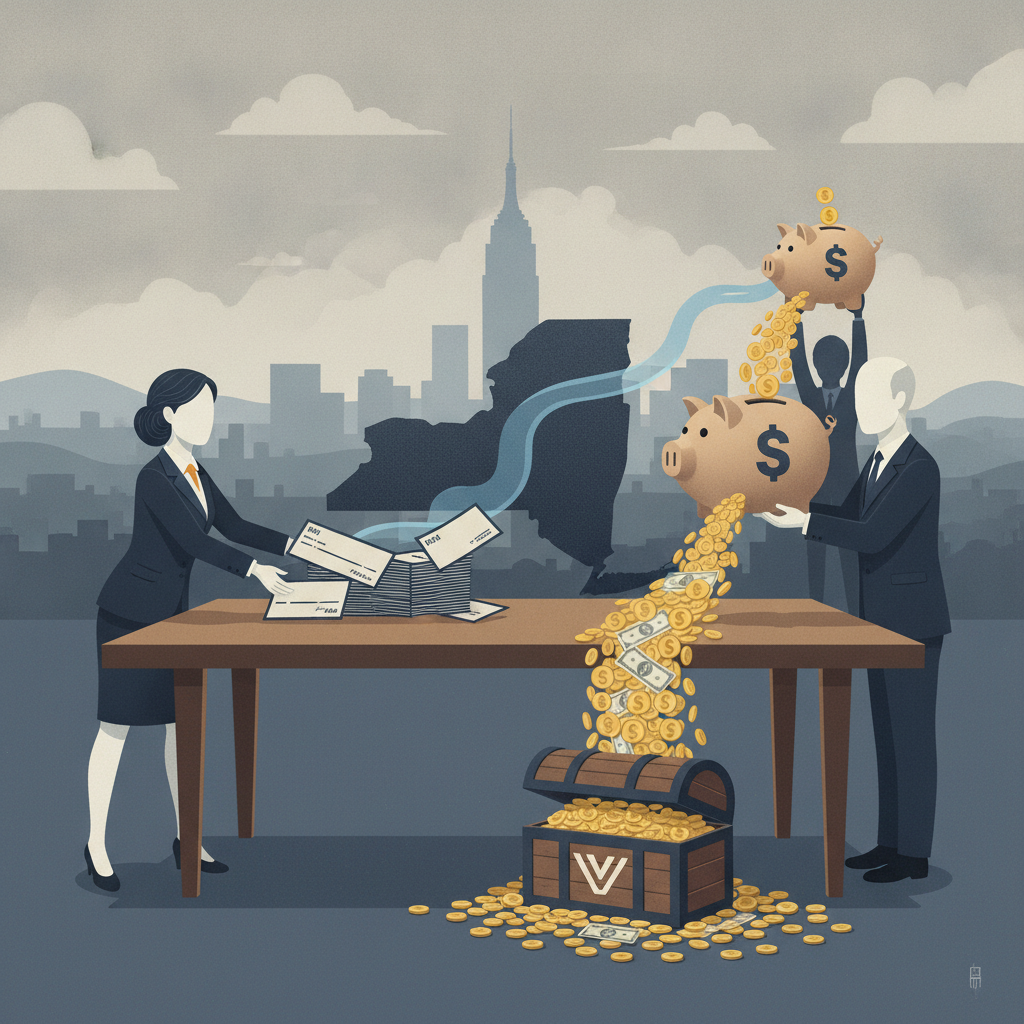
New York Governor Kathy Hochul returned millions of dollars in contributions after officials canceled her June primary. However, more than 360 refunded donors redirected $2.6 million to the New York State Democratic Committee within days. Subsequently, the state party transferred $10 million back into her general election campaign.
State law allows individuals to contribute $9,000 for a primary and $9,000 for a general election. Over four years, more than 500 donors gave Hochul the maximum $18,000 total. Then, Lieutenant Governor Antonio Delgado ended his primary challenge. As a result, the state canceled the Democratic primary election.
Where do New York governor election funds originate and travel?
Because the primary race disappeared, state law required Hochul to return excess donor funds. Her campaign processed hundreds of refunds to maxed-out contributors. However, campaign staff quickly offered donors a secondary option. Specifically, staffers contacted refunded contributors and provided forms to direct those funds to the state party committee.
Records indicate 363 donors received refunds. They then gave matching amounts to the state Democratic party within three days. Meanwhile, the state party poured millions into supporting Hochul’s candidacy. In September alone, the party transferred $10 million to her main campaign war chest.
Why does the NY Democratic Party campaign refund process raise legal questions?
This funding strategy highlights a longstanding legal pathway in New York election regulation. Individual candidates face strict donation limits under state rules. Conversely, political party committees can accept much larger individual contributions. Furthermore, party committees can transfer unlimited sums directly to candidate campaigns without facing state caps.
Campaign spokesperson Ryan Radulovacki stated that staff contacted supporters after issuing official refunds. Next, staff informed donors that they could support party candidates up and down the ticket. Supporters who agreed signed documents directing their reimbursed funds straight to the state party.
Meanwhile, good-government advocates argue that the practice bypasses standard contribution caps. Blair Horner, senior policy adviser for the New York Public Interest Research Group, criticized the broader setup. “It’s a ridiculous system that New York has, where the public thinks that campaign contributions are enforced, when in reality, for Albany’s fat cats, they’re not,” Horner said.
What role do major donors play in Kathy Hochul campaign donations?
Many prominent business leaders, corporate executives, and political action committees participated in the refund transfer strategy. For instance, dozens of real estate developers, sports executives, and industry groups redirected their returned money. They sent these funds into state party accounts within three days of receiving their campaign refunds.
- Steve Cohen, owner of the New York Mets and casino developer
- Reed Hastings, co-founder of Netflix
- Leonard Blavatnik, billionaire businessman and investor
- Lou Coletti, lobbyist and former construction association leader
- Political action committees representing healthcare, horseracing, and funeral directors
Lou Coletti confirmed that campaign representatives contacted him after returning his $9,000 contribution. “I had maxed out with the governor, so they asked if I would consider supporting the party and I said yes,” Coletti noted.
Still, not every refunded contributor chose to redirect funds to the party committee. Records show 141 donors kept their returned money totaling over $900,000. For example, Nancy McCartney kept her refund rather than giving to the party.
What comes next for New York campaign finance oversight?
Party transfers remain a standard strategy for candidates across both major political parties in New York State. For instance, Republican candidate Bruce Blakeman received roughly $3.5 million from the Nassau County Republican Committee. Still, state party committees continue to face public scrutiny over unlimited transfer rules.
In past years, similar fundraising efforts drew severe warnings from law enforcement officials. Specifically, in 2014, state prosecutors reviewed fundraising efforts by New York City Mayor Bill de Blasio. Ultimately, prosecutors declined to file criminal charges. However, they strongly criticized the strategy as an end run around donor caps.
Therefore, ethics reformers continue demanding comprehensive campaign reform across New York State. As election day approaches, local border residents can expect heavy campaign spending. State party committees will continue to fuel this regional outreach.
This article was produced with the assistance of AI and reviewed by our editorial team.
Sources
Related: Bruce Blakeman Campaign Finance Audits Raise Questions for Neighboring New York Voters
Related: NY Election Watchdog Waives Fines for Bronx Democrats After Late Filings
Related: New York Governor Race: Key Issues for Border Residents
See a typo? Report it here.