Bennington
Tasa Coffee Roasters Chicago closed following community protests over ICE allegations
Tasa Coffee Roasters appears “permanently closed” after customers accuse co-owner of working for ICE Latino-Owned Coffee Shop Closes After Claims That Founder Works for ICE Humboldt Park coffee shop closes amid protests over alleged ICE ties Humboldt Park Coffee Shop…


Last updated:
Key points
- Tasa Coffee Roasters permanently closed in November 2026 after claims surfaced linking co-owner Pierre Marquez to ICE.
- Staff members walked out and posted a sign refusing to work with anyone tied to federal immigration enforcement.
- Protests, storefront vandalism, local business boycotts, and an arrest outside the shop quickly led to the final shutdown.
NewsWK — A high-profile Midwest business shutdown shows how public accountability, municipal grant funding, and community values collide. Furthermore, events surrounding a recent café closure offer key insights into local commercial oversight and public trust.
Why is Tasa Coffee Roasters Chicago closed after community protests?
Tasa Coffee Roasters permanently shut its doors in November 2026 following intense community protests and employee walkouts. The shutdown occurred after online reports connected a co-owner to federal immigration enforcement. Consequently, workers immediately resigned and storefront windows suffered vandalism. In addition, civic leaders withdrew official support from the establishment.
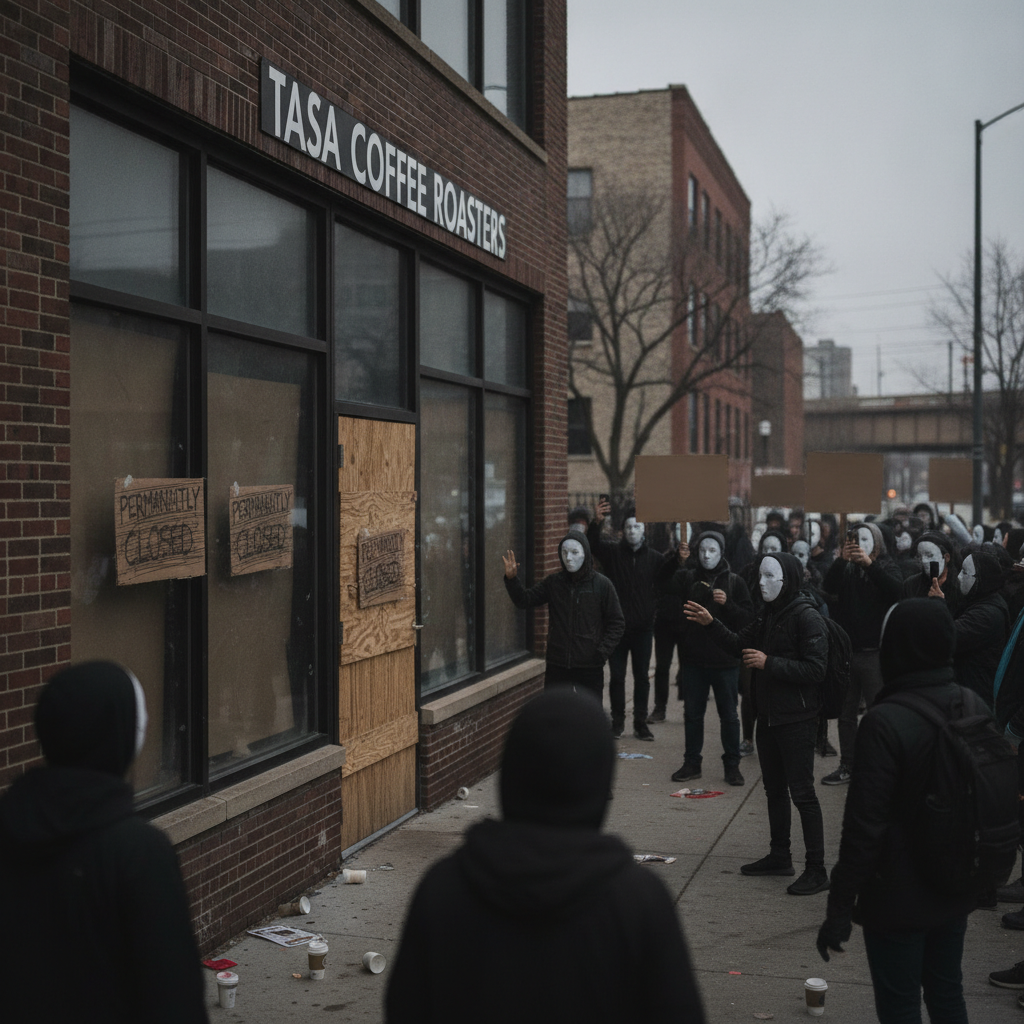
The West Humboldt Park café officially posted a “Permanently CLOSED” sign in its window on Tuesday, November 24, 2026. Just one day earlier, baristas and roasters walked off their jobs in protest. Then, they taped a handwritten message to the front glass. The note stated their refusal to work alongside federal enforcement personnel.
The note directly stated: “After finding out from Reddit, that there are allegations Pierre Marquez is an ICE agent, we the baristas and roasters have closed for the day. We do not stand beside, condone, support, or accept anyone or any org associated with ICE.” Soon after, management removed the handwritten note. They replaced it with a permanent closure notice.
What caused the Tasa Coffee Roasters ICE allegations?
The intense controversy began on Sunday, November 22, 2026. That day, an online post linked co-owner Pierre Cesar Marquez to U.S. Immigration and Customs Enforcement. A public database listed him as a supervisory detention officer. Additionally, public records quickly tied his name to Department of Homeland Security employment and official agency email addresses.
The post appeared on a Humboldt Park online forum. Specifically, it cited entries from an unofficial public database tracking immigration enforcement personnel. Researchers then examined public records. As a result, they found matches linking Pierre Marquez to Department of Homeland Security rosters.
However, federal officials declined to confirm or deny his employment status. Federal agency representatives stated they do not release officer identities because public disclosures create safety risks. Meanwhile, business co-founder Jackie Marquez defended her position in an Instagram statement. She stated she is the sole owner of Tasa Coffee Roasters. Furthermore, she personally disagrees with federal immigration policies.
Who is Pierre Marquez ICE agent Chicago according to public records?
Public records link Pierre Cesar Marquez to federal employment under the Department of Homeland Security. Specifically, documents indicate a supervisory role in deportation operations in the Chicago region. However, agency representatives refuse to publicly verify individual employment files. They cite personal safety policies regarding officer identity disclosures.
Jackie Marquez launched the coffee shop in 2022 at 4136 W. North Ave. Official municipal records list her as the sole legal owner of the business enterprise. Because of that structure, the business qualified for city grants. For instance, it received a Neighborhood Opportunity Fund grant in 2022 and a Good Food Fund grant in 2025.
What happened during the Humboldt Park coffee shop closure?
Tensions rapidly escalated outside the storefront as neighbors, former patrons, and activists staged demonstrations. Protesters threw eggs at the windows and sprayed red graffiti across the exterior walls. Furthermore, police arrested a relative of the owner outside the building. The arrest occurred after he displayed a firearm during an interview with reporters.
Local business partners quickly severed ties with the roaster. For example, Lori Torres, owner of nearby Chelsea’s Café, stopped purchasing coffee beans from the company. Additionally, customers published videos online in solidarity with the boycott. These videos showed them pouring Tasa coffee down kitchen drains.
Political support collapsed rapidly as well. U.S. Representative Delia Ramirez and members of the Northwest Side Progressive Coalition formally denounced the business. Meanwhile, Chicago Mayor Brandon Johnson offered a clarification through a spokesperson. Specifically, his administration had no prior knowledge of any federal law enforcement ties during previous shop visits for ward programs.
What does the Tasa Coffee Roasters Humboldt Park situation mean for local business ethics?
Events surrounding Tasa Coffee Roasters highlight how quickly public trust, public funding, and ethics intersect in modern commerce. Ultimately, it demonstrates how community accountability impacts business operations, municipal grant distributions, and public transparency in local neighborhoods.
Small towns and larger cities alike face growing scrutiny over municipal grant awards and ethical transparency. Today, public money often supports local retail establishments. Consequently, communities expect alignment with local values and complete honesty regarding executive leadership.
Therefore, municipal oversight and strong workplace ethics remain essential for maintaining community trust. Consumers increasingly vote with their wallets. Because of this trend, business owners must navigate complex political realities to survive in competitive markets.
This article was produced with the assistance of AI and reviewed by our editorial team.
Sources
Related: Schools Revisit Immigration Enforcement Rules as Federal Policies Shift
Related: Discovering The Coffee Bar Bennington: A Local Gem for Quality Brews