New York
No Solution to Health Coverage Cliff in Delayed State Budget
This story originally appeared in New York Focus, a nonprofit news publication investigating power in New York. Sign up for their newsletter here. By Jie Jenny Zou | New York Focus The state budget does not provide a plan for the hundreds of thousands of New Yorkers set to lose their health care in July, disappointing lawmakers and advocates who had urged Governor Kathy Hochul to act in the final weeks of Albany negotiations. Earlier this year, budget proposals by the Senate, Assembly, and governor called for robust funding increases for Medicaid providers like hospitals, but none addressed what would happen to the estimated 450,000 New Yorkers set to be kicked off the state’s Essential Plan this summer. The flagship program provides free or low-cost health care to 1.7 million residents ineligible for Medicaid, enabling the state to maintain near-universal insurance coverage. But federal cuts that took effect earlier this year will eliminate coverage for those in the program who earn between 200 and 250 percent of the federal poverty level. Tightened eligibility criteria will also terminate coverage for some immigrants with legal status who earn even less. In late March, Assemblymember Amy Paulin and Senator Gustavo Rivera, who chair their chambers’ respective health committees, proposed bills that would require the state to continue covering these New Yorkers, which one report estimated would cost $2.3 billion annually. Both bills racked up dozens of co-sponsors, who also signed onto a recent letter imploring Hochul to support the bills. The governor has said that no state can afford to backfill federal cuts. The letter, co-authored by Rivera and Paulin, argued that the governor had already set aside the needed funds in her January budget proposal. She had reserved over $2 billion to provide health insurance to some New Yorkers in the event that the state did not secure federal approval to keep the Essential Plan alive in a scaled-back form. The state received that approval in March, leaving the contingency funds unused. That argument ultimately failed to gain traction in negotiations. The state did not allocate money to address the Essential Plan cliff, rendering Rivera’s and Paulin’s bills moot during the rest of the legislative session. The budget contains hefty rate increases for health care providers, a move that some advocates say prioritizes the interests of the health care lobby over those of working-class New Yorkers. “It really speaks to the degree to which, in Albany health politics, the voices of patients are not focused on,” said Michael Kinnucan, health policy director of the Fiscal Policy Institute. “It’s a really astonishing abdication of responsibility,” he said of Hochul, Assembly Speaker Carl Heastie, and Majority Leader Andrea Stewart-Cousins. The budget does include a 2.7 percent increase in payments to contracted human services providers — below the 4 percent requested by both chambers, but above Hochul’s proposal of 1.7 percent. Nonprofits provide a range of critical services like emergency shelters, but the sector has been fettered by stagnant wages. But the budget stops short of including a Senate proposal to expand the number and type of providers included in the annual increase to cover excluded groups like domestic violence workers. “We wish we didn’t have to fight so hard for the basics,” said Michelle Jackson of the Human Services Council of New York. The final budget funded two nutrition programs, the Hunger Prevention and Nutrition Assistance Program and Nourish NY, at $72.8 million and $55 million respectively. (Both legislative chambers had proposed funding $75 million each.) The programs support the state’s vast network of emergency food providers, which have experienced historic demand amid worsening food insecurity and reduced federal support. The chambers appeared to prevail with one program: The budget allocates $8.7 million for the state’s network of community-based navigators that help residents apply and certify for the Supplemental Nutrition Assistance Program, known as food stamps. That’s roughly in line with the legislature’s proposals and far exceeds Hochul’s proposal of $3.7 million. Ryan Healy of Hunger Solutions New York said the funding will fully compensate for the federal dollars that program lost at an especially critical time. New work rule requirements went into effect for SNAP recipients this spring, causing mass confusion. “Sustaining that network really shows New York is committed to helping families access SNAP,” Healy said, calling the funding a “highlight” of the budget. Originally published by New York Focus. By Jie Jenny Zou, New York Focus. Read the original story.

Last updated:
This story originally appeared in New York Focus, a nonprofit news publication investigating power in New York. Sign up for their newsletter here.
No Solution to Health Coverage Cliff in Delayed
The state budget does not provide a plan for the hundreds of thousands of New Yorkers set to lose their health care in July, disappointing lawmakers and advocates who had urged Governor Kathy Hochul to act in the final weeks of Albany negotiations.
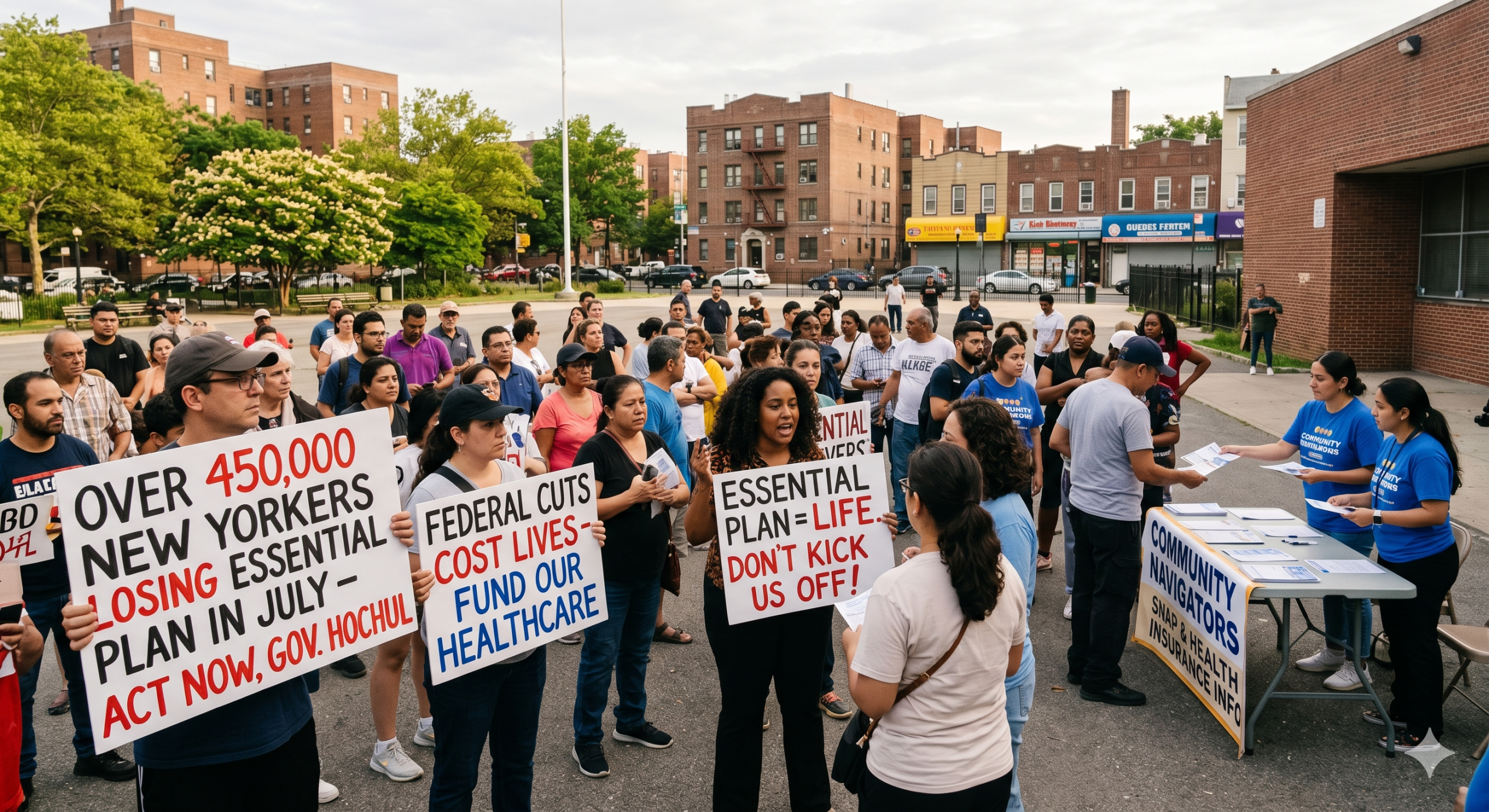
Earlier this year, budget proposals by the Senate, Assembly, and governor called for robust funding increases for Medicaid providers like hospitals, but none addressed what would happen to the estimated 450,000 New Yorkers set to be kicked off the state’s Essential Plan this summer.
The flagship program provides free or low-cost health care to 1.7 million residents ineligible for Medicaid, enabling the state to maintain near-universal insurance coverage. But federal cuts that took effect earlier this year will eliminate coverage for those in the program who earn between 200 and 250 percent of the federal poverty level. Tightened eligibility criteria will also terminate coverage for some immigrants with legal status who earn even less.
In late March, Assemblymember Amy Paulin and Senator Gustavo Rivera, who chair their chambers’ respective health committees, proposed bills that would require the state to continue covering these New Yorkers, which one report estimated would cost $2.3 billion annually. Both bills racked up dozens of co-sponsors, who also signed onto a recent letter imploring Hochul to support the bills.
The governor has said that no state can afford to backfill federal cuts.
The letter, co-authored by Rivera and Paulin, argued that the governor had already set aside the needed funds in her January budget proposal. She had reserved over $2 billion to provide health insurance to some New Yorkers in the event that the state did not secure federal approval to keep the Essential Plan alive in a scaled-back form. The state received that approval in March, leaving the contingency funds unused.
That argument ultimately failed to gain traction in negotiations. The state did not allocate money to address the Essential Plan cliff, rendering Rivera’s and Paulin’s bills moot during the rest of the legislative session.
The budget contains hefty rate increases for health care providers, a move that some advocates say prioritizes the interests of the health care lobby over those of working-class New Yorkers. “It really speaks to the degree to which, in Albany health politics, the voices of patients are not focused on,” said Michael Kinnucan, health policy director of the Fiscal Policy Institute.
“It’s a really astonishing abdication of responsibility,” he said of Hochul, Assembly Speaker Carl Heastie, and Majority Leader Andrea Stewart-Cousins.
The budget does include a 2.7 percent increase in payments to contracted human services providers — below the 4 percent requested by both chambers, but above Hochul’s proposal of 1.7 percent. Nonprofits provide a range of critical services like emergency shelters, but the sector has been fettered by stagnant wages.
But the budget stops short of including a Senate proposal to expand the number and type of providers included in the annual increase to cover excluded groups like domestic violence workers. “We wish we didn’t have to fight so hard for the basics,” said Michelle Jackson of the Human Services Council of New York.
The final budget funded two nutrition programs, the Hunger Prevention and Nutrition Assistance Program and Nourish NY, at $72.8 million and $55 million respectively. (Both legislative chambers had proposed funding $75 million each.) The programs support the state’s vast network of emergency food providers, which have experienced historic demand amid worsening food insecurity and reduced federal support.
The chambers appeared to prevail with one program: The budget allocates $8.7 million for the state’s network of community-based navigators that help residents apply and certify for the Supplemental Nutrition Assistance Program, known as food stamps. That’s roughly in line with the legislature’s proposals and far exceeds Hochul’s proposal of $3.7 million.
Ryan Healy of Hunger Solutions New York said the funding will fully compensate for the federal dollars that program lost at an especially critical time. New work rule requirements went into effect for SNAP recipients this spring, causing mass confusion.
“Sustaining that network really shows New York is committed to helping families access SNAP,” Healy said, calling the funding a “highlight” of the budget.
Originally published by New York Focus. By Jie Jenny Zou, New York Focus. Read the original story.