Bennington
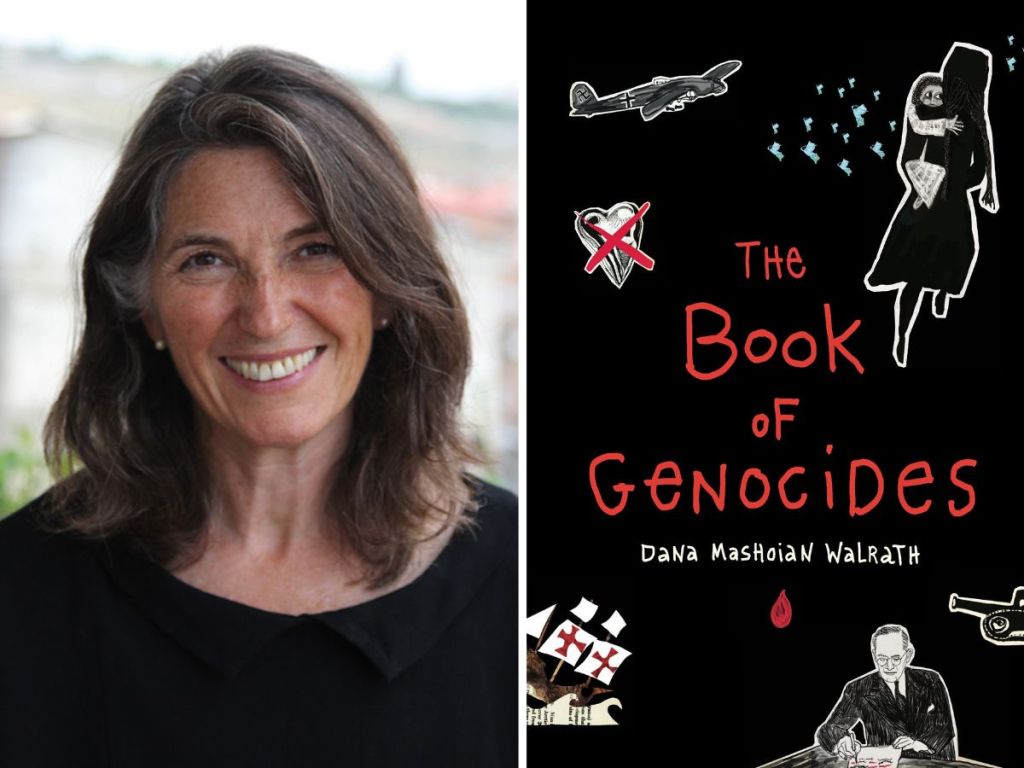
Dana Mashoian Walrath The Book of Genocides Traces History
For her latest graphic narrative work, “The Book of Genocides,” Walrath’s research took her to 10 regions where she met survivors, descendants, and communities struggling with the legacy of violence. Read the story on VTDigger here: Vermont Conversation: ‘We are…


Last updated:
Key points
- Author and anthropologist Dana Mashoian Walrath traces patterns across 10 historical genocides in her new 424-page graphic narrative.
- Walrath warns that mass atrocities build gradually through land theft, dehumanization, and divisive political rhetoric.
- The book emphasizes that caring for others is humanity’s natural state, offering a message of hope and reconciliation for local communities.
MONTPELIER, Vt. NewsWK — Dana Mashoian Walrath recently released her 424-page graphic narrative to examine the roots of global atrocities. Specifically, the work focuses on how historical patterns repeat across centuries and continents. Residents in Bennington County and across Southern Vermont can gain crucial insights from her perspective. Her work explores human behavior and community survival. In addition, Walrath recently shared details about her research on the Vermont Conversation podcast.
What lessons does Dana Mashoian Walrath bring to Vermont readers?
Vermont readers often look for ways to understand complex global events through personal and community actions. Dana Mashoian Walrath offers a powerful lens for local residents to evaluate systemic discrimination and political speech. Ultimately, her study shows that peaceful societies require active defense against divisive rhetoric and institutional injustice.
Walrath emphasizes that people learn hatred rather than inherit it as an innate human trait. Because societies teach hatred, communities can also choose to unlearn destructive patterns. They can achieve this shift through education and empathy.
Furthermore, the research highlights several key historical locations and events across five centuries:
- Indigenous displacement in North America and Australia
- The Armenian genocide in the early 20th century
- Mass atrocities in Bosnia, Cambodia, and Rwanda
- Targeted violence in Gaza and against the Rohingya in Myanmar
What does Dana Walrath Vermont author reveal in her new graphic narrative?
Dana Walrath Vermont author combines rigorous academic scholarship with graphic artwork to trace 10 major historical atrocities. She demonstrates that mass violence rarely happens overnight. Instead, atrocities build through predictable stages before mass killing begins. For example, these stages include land theft, political manipulation, and systematic dehumanization.
Walrath holds a doctorate in anthropology from the University of Pennsylvania. This academic background provided the structural tools to analyze global injustices. Moreover, her personal family history as descendants of Armenian genocide survivors gave her a direct connection. A high school teacher once asked her what to know about Armenians besides rugs. Consequently, that moment sparked her lifelong effort to link human stories across historical tragedies.
To complete the 424-page volume, Walrath traveled to all 10 regions depicted in her work. She interviewed survivors, descendants, and community leaders in each location. For instance, she visited a reconciliation village in Rwanda. There, former perpetrators and survivors live together. She also walked through the historic supply tunnel in Sarajevo and met a prison survivor in Cambodia.
However, the intensive fieldwork created severe personal challenges. After visiting Auschwitz, the scale of industrial destruction caused her deep grief. Still, her daily practice of drawing and writing helped her cope. Creative expression provided a meaningful way to counter violence.
What key themes highlight the Vermont Conversation podcast discussion?
During the Vermont Conversation podcast appearance, Walrath outlined how structural warnings apply to modern American political discourse. She cautioned against language that brands political opponents as internal enemies. In fact, historical analysis shows that such polarizing terminology often precedes deeper societal divisions and institutional breakdown.
Walrath explained that public discussions during The Book of Genocides interview often focus only on mass killings. Meanwhile, people frequently ignore the underlying processes. Then she noted that land acquisition and Economic Motives Frequently Drive systemic violence. Furthermore, dehumanizing language lays the foundation for physical harm against vulnerable groups.
“Genocide tends to just get used for massive massacres, and it loses track of all the processes that underlie those massacres,” Walrath said.
Despite the heavy subject matter, Walrath maintains hope for future generations. She stresses that human biology drives people to care for one another. Therefore, communities retain the power to dismantle systems of conquest and hatred.
“We are hardwired to care for each other, rather than hardwired for violence,” Walrath said. “We are taught to hate. Its not that were hardwired to hate.”
Previously, Walrath published “Aliceheimers,” a graphic memoir detailing her mothers journey with dementia. She also wrote the novel “Like Water on Stone.” Additionally, her short works have appeared in publications such as NPR, Slate, and The Nation. Currently, she is working on her next book project. That upcoming volume will focus on reconciliation, forgiveness, and healing historical wounds.
This article was produced with the assistance of AI and reviewed by our editorial team.
Sources
Related: Changes in Immigration Protections Domestic Violence Bennington Advocates Warn of Stricter Rules
Related: States Push for Closer Review in Domestic Violence Deaths