Albany
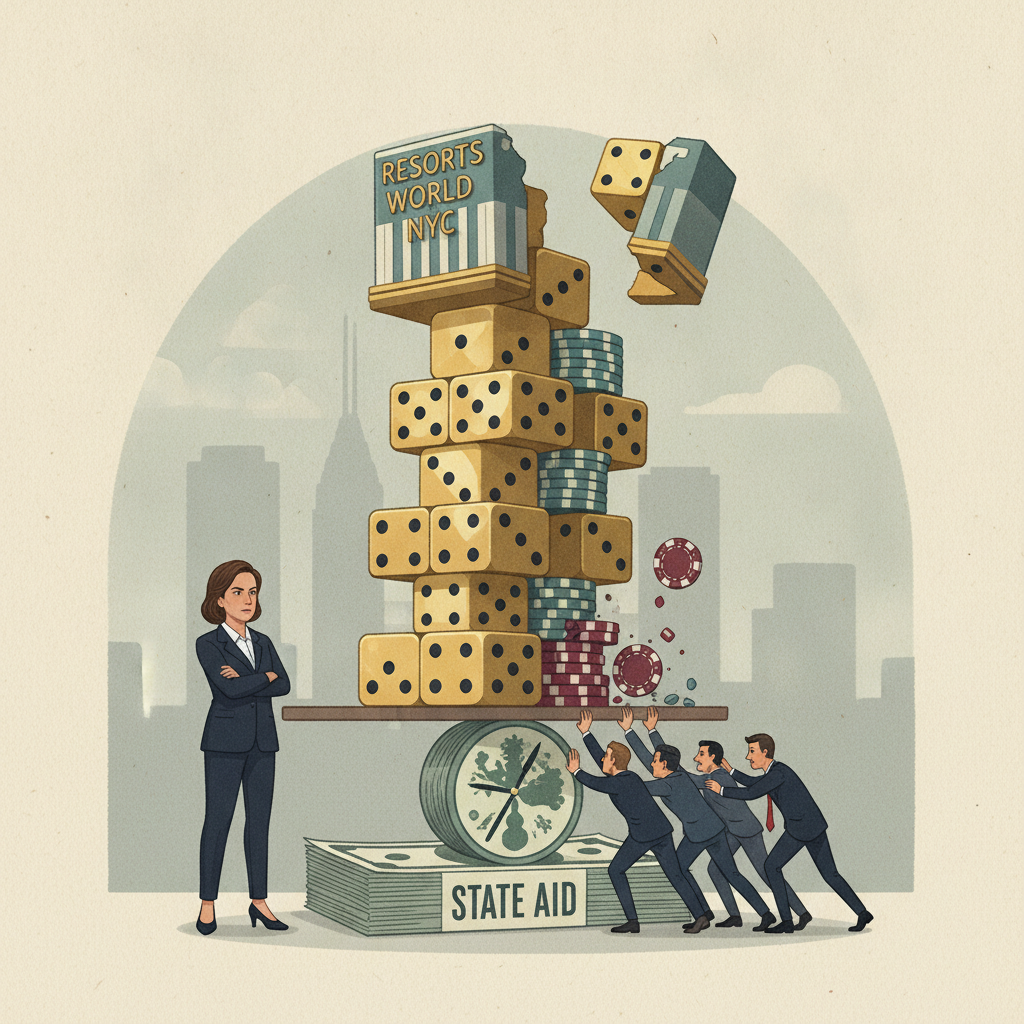
Resorts World NYC Tax Dispute Puts Millions in State Aid at Risk
Queens lawmakers are joining Resorts World’s push, saying the casino expansion could otherwise collapse. Governor Hochul isn’t budging.

Last updated:
Key points
- Resorts World argues its 56 percent tax rate includes $150 million in annual horse racing subsidies, but state officials disagree.
- The operator warns that higher payments could imperil a planned $3.3 billion expansion at Aqueduct Racetrack.
- Governor Kathy Hochul stands firm to protect projected state tax revenues earmarked for public education and mass transit.
NewsWK — New York state officials and casino operators face an escalating financial showdown. At issue is whether downstate casino operators can trim their payments to the state. Consequently, the resorts world nyc tax dispute puts massive sums of expected state aid in jeopardy.
For local residents across Rensselaer and Washington counties, gaming revenue matters. In addition, these state receipts help fund public schools and transit systems across New York.
Why it matters
State budget collections directly affect local tax burdens and municipal services across New York. State leaders expect downstate gaming proceeds to fund classrooms and regional transit routes. Therefore, if casino receipts drop, lawmakers in Albany face tough budget choices. Upstate communities could also lose vital aid. Furthermore, millions in racing subsidies support agricultural jobs across eastern New York.
What sparked the Kathy Hochul casino tax dispute?
The Kathy Hochul casino tax dispute centers on whether a 56 percent tax rate includes mandatory horse racing subsidies. State officials argue that statute keeps racing support separate from casino taxes. Meanwhile, Resorts World New York City claims its initial bid bundled both payments. That interpretation would save the operator roughly $150 million every year.
Resorts World currently operates at the Aqueduct Racetrack site in Jamaica, Queens. It became the first full downstate commercial casino when it opened in April. However, company leaders argue that separate racing funds push their effective slot tax rate to 72 percent.
Still, state officials strongly reject that calculation. Hochul spokesperson Gordon Tepper made the administration’s stance clear.
“By law, tax rates do not, and have never, included racing support payments,” Tepper said.
Soon after, state budget officials confirmed their reliance on the higher expected income. A state report projected Resorts World would pay about $4 billion for schools and transit over a decade.
How does the ny gaming commission casino tax rate affect lenders?
The ny gaming commission casino tax rate shapes how private banks evaluate long-term casino debt. Regulators originally warned that the Queens project relied heavily on future borrowing. Because construction requires substantial capital, executives claim higher tax rates could scare away prospective lenders and stall progress.
Queens State Sen. Joe Addabbo warned that private lenders might balk at the higher figures.
“Based on what they tell me, the jeopardy comes with the lenders,” Addabbo said.
However, critics counter that the company chose its own bid terms during the licensing process. NYU law professor Vicki Been previously chaired the state board reviewing the bids. In addition, she noted that regulators explicitly told applicants that bid tax rates were final.
What is at risk for the Resorts World Queens expansion?
The Resorts World Queens expansion involves an ambitious $3.3 billion upgrade at Aqueduct Racetrack. The proposal adds thousands of new gaming positions alongside major lodging and entertainment spaces. Yet casino executives have signaled that they might halt work if New York enforces the higher tax rate.
Resorts World held a formal groundbreaking ceremony for the complex in July. For example, the planned facility features several major components:
- A 2,000-room hotel and entertainment arena
- 6,000 video slot machines and 800 table games
- 5,000 projected permanent jobs by 2029
- Over $500 million in contested tax and racing commitments
Meanwhile, rival developers will not face the same initial tax hurdles. New venues planned for the Bronx and Queens require complete ground-up construction. Therefore, those sites will not open until 2030, leaving Resorts World to carry racing payments alone. In addition, those competitors negotiated baseline tax rates of only 25 and 30 percent.
What comes next for New York casino taxes?
New York casino taxes will remain a heated battleground between Albany officials and gambling representatives. Lawmakers previously postponed the fight during the regular spring legislative session. However, a looming legal deadline quickly forced both parties to confront the financial standoff directly as budget negotiations approach.
Resorts World continues to deploy substantial lobbying muscle throughout the state capital. For instance, records show the parent company Genting keeps seven distinct lobbying firms on its payroll. Still, Governor Hochul shows little desire to reduce the state’s projected revenue. If negotiations fail, the conflict will inevitably proceed into state courts. As a result, regional taxpayers will monitor the outcome as Albany prepares its next annual budget.
This article was produced with the assistance of AI and reviewed by our editorial team.
Sources
Related: Border County Tax Pressures Mount as New York Shifts SNAP Costs
Related: Bennington Battle Day Marked as Historic Monument Awaits Repairs
See a typo? Report it here.