Bennington, VT News
Bennington PFAS Water Testing Urged as Contamination Plume Expands
A “generational disaster” continues to slowly unfold across Bennington County. Recent scientific findings reveal that the regional plume of toxic per- and polyfluoroalkyl substances (PFAS) is both expanding and intensifying, prompting state environmental officials to launch an urgent free well-testing blitz in newly impacted areas.

Last updated:
BENNINGTON, Vt. NewsWk — A “generational disaster” continues to slowly unfold across Bennington County. Recent scientific findings reveal that the regional plume of toxic per- and polyfluoroalkyl substances (PFAS) is both expanding and intensifying, prompting state environmental officials to launch an urgent free well-testing blitz in newly impacted areas.
The contamination—stemming from decades of emissions from the former ChemFab factory—has officially breached past initial containment boundaries. Private wells in Southern Bennington and southeastern Shaftsbury are now showing elevated levels of perfluorooctanoic acid (PFOA), a pervasive and toxic type of PFAS commonly known as a “forever chemical.”
ChemFab PFOA Contamination Bennington Plume Continues to Spread
The expanded testing push comes in the wake of joint research conducted by Bennington College professors and student researchers in partnership with the Vermont Department of Environmental Conservation (DEC).
Analyzing nearly a decade of groundwater data, researchers uncovered a disturbing temporal trend: far from dissipating, PFOA levels are steadily rising in the region’s groundwater. Out of hundreds of private wells tracked between 2016 and 2024, approximately three-quarters showed increased chemical concentrations over the eight-year window.
“PFAS is a generational disaster, and we’re only now starting to figure out what it means to respond to an environmental crisis of this scale and this durability,” said David Bond, a Bennington College professor and co-lead on the research project.
The state recently tightened its regulatory grip, narrowing the maximum allowable level of PFOA in its Groundwater Protection Rule down to a strict 4 parts per trillion (ppt). However, recent testing in the newly affected Southern Bennington and Shaftsbury zones uncovered concentrations reaching as high as 60 ppt—fifteen times the state’s health threshold. Most affected wells registered between 20 ppt and 30 ppt.
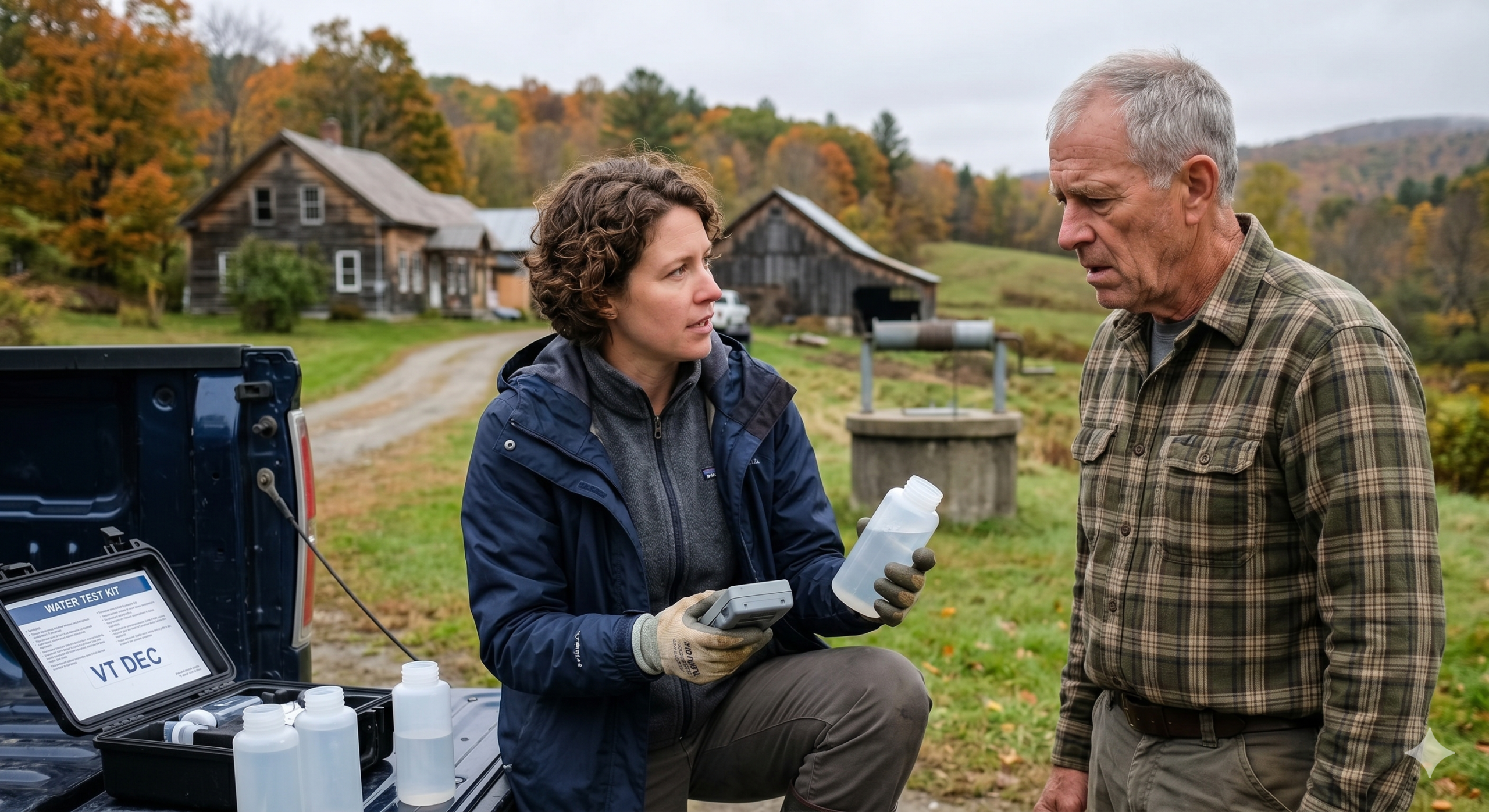
Vermont DEC Free Water Testing Bennington Program and Emergency Relief
Shaftsbury PFAS Well Testing and Southern Area Sampling
In response to the migrating plume, the DEC’s Sites Management Section has launched an aggressive sampling campaign aiming to test roughly 250 wells in Southern Bennington and 50 wells in Shaftsbury. State hazardous site managers note that while outreach is actively underway, many households in the zone have yet to respond.
For residents whose wells return results exceeding the new 4 ppt safety standard, the state is deploying immediate, tiered relief measures at no cost to property owners:
- Immediate Clean Water Support: Affected households are receiving scheduled bottled water deliveries or having specialized point-of-entry treatment (POET) filtration systems installed.
- Long-Term Infrastructure Goals: State officials confirm that planning is currently underway to extend municipal water lines to the Southshire neighborhood, with the ultimate goal of connecting all impacted communities to a public water supply entirely insulated from PFAS contamination.
State project managers are urging all residents within the newly designated southern Bennington and Shaftsbury area of concern to request free testing immediately.
Bennington County PFAS Relief & Testing Contacts:
• Richard Spiese (VT DEC): richard.spiese@vermont.gov | 802-249-5083
• Malayika Vincent (VT DEC): malayika.vincent@vermont.gov | 802-505-1351
Legal and Local Blowback
The physical spread of the chemicals has catalyzed swift community and legal backlash. Attorneys representing local property owners recently held a meeting with roughly 100 residents in the newly impacted zones to lay the groundwork for a potential class-action lawsuit aimed at securing legal redress for toxic exposure and property devaluation.
Concurrently, the Shaftsbury Select Board has formally petitioned the state to expand its response, demanding that Vermont provide comprehensive blood testing for residents exposed to the migrating plume—a request local leaders argue is strictly aligned with the growing body of scientific literature regarding the long-term health risks of PFOA accumulation.
Related: Bennington 250 Announces ‘250 for 250’ Year-End Gala to Support Anniversary Celebrations
Related: Bennington Battle Day Marked as Historic Monument Awaits Repairs
Related: Warm, Cloudier Pattern Sets In for Bennington County Before Weekend Drizzle and Cooler Air
Related: Damp Late-August Stretch Brings Rain, Drizzle, and Cooler Temperatures to Bennington County
Related: Border County Tax Pressures Mount as New York Shifts SNAP Costs
Related: Smithsonian Partners With Bennington Groups for Cultural Initiative
See a typo? Report it here.